Quick verdict: the product is credible; the plan choice is the real work
FTMO Futures is not one evaluation with two price tags. PRO and GROWTH expose traders to different failure modes. PRO gives the 50K evaluation more maximum-loss room and a less restrictive consistency objective, but a hard daily-loss breach remains active. GROWTH removes the evaluation daily-loss limit, yet leaves less total room and requires profits to be distributed more evenly.
Our preferred way to choose is simple: take a representative slice of your own closed trades, preserve the original sequence and fees, and replay it against both exact rule sets. The first binding constraint tells you more than the cheaper subscription, the larger withdrawal headline, or the FTMO name.
What we actually tested
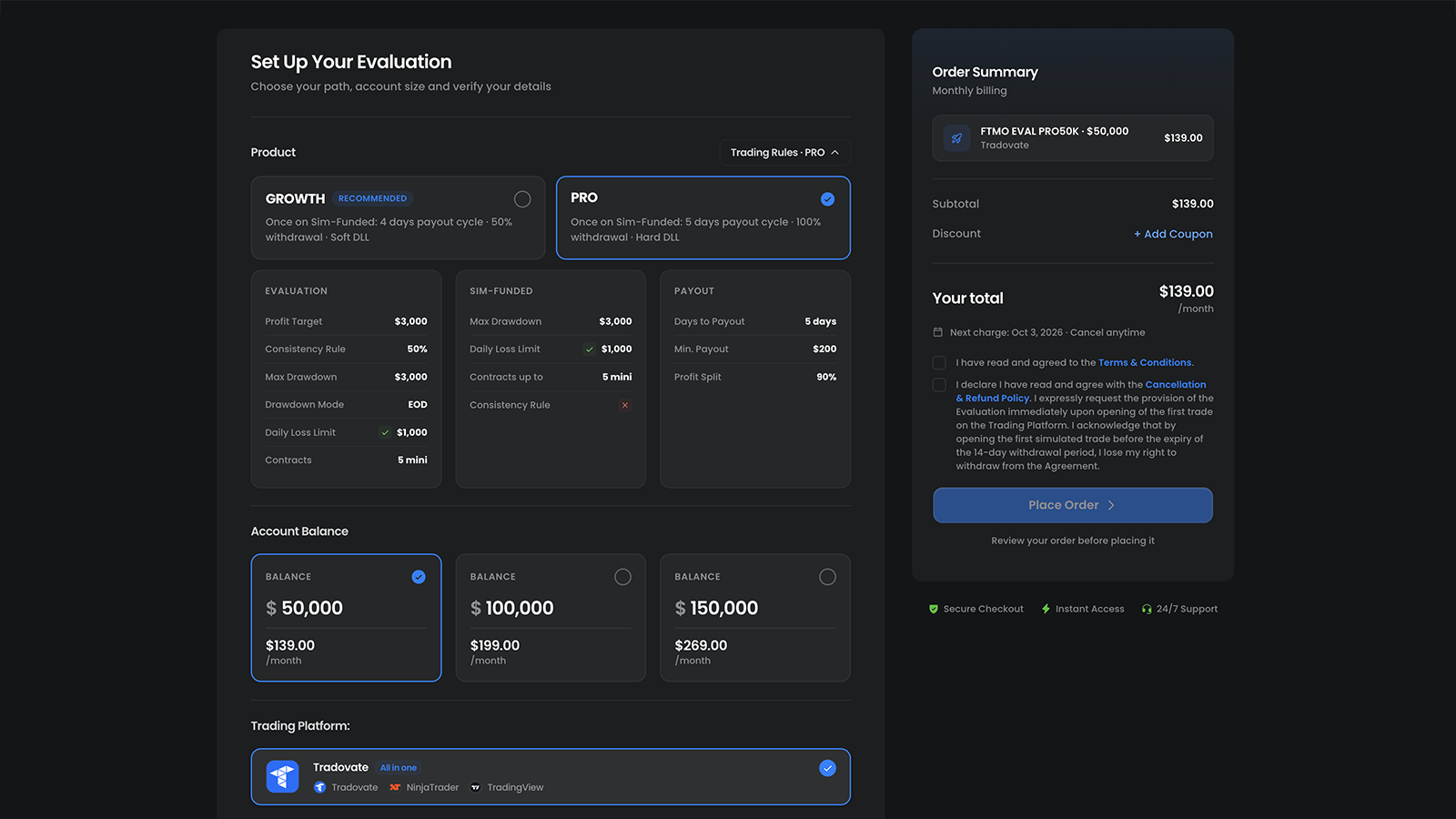
This review includes a live hands-on pass through a private PRO 50K evaluation account: checkout, account activation, the objectives dashboard, Tradovate access, closed-trade reporting, fee reconciliation, and a TSB rule replay. It does not claim a payout was requested or received. It does not turn nine observed closed round trips into evidence about the whole trader population.
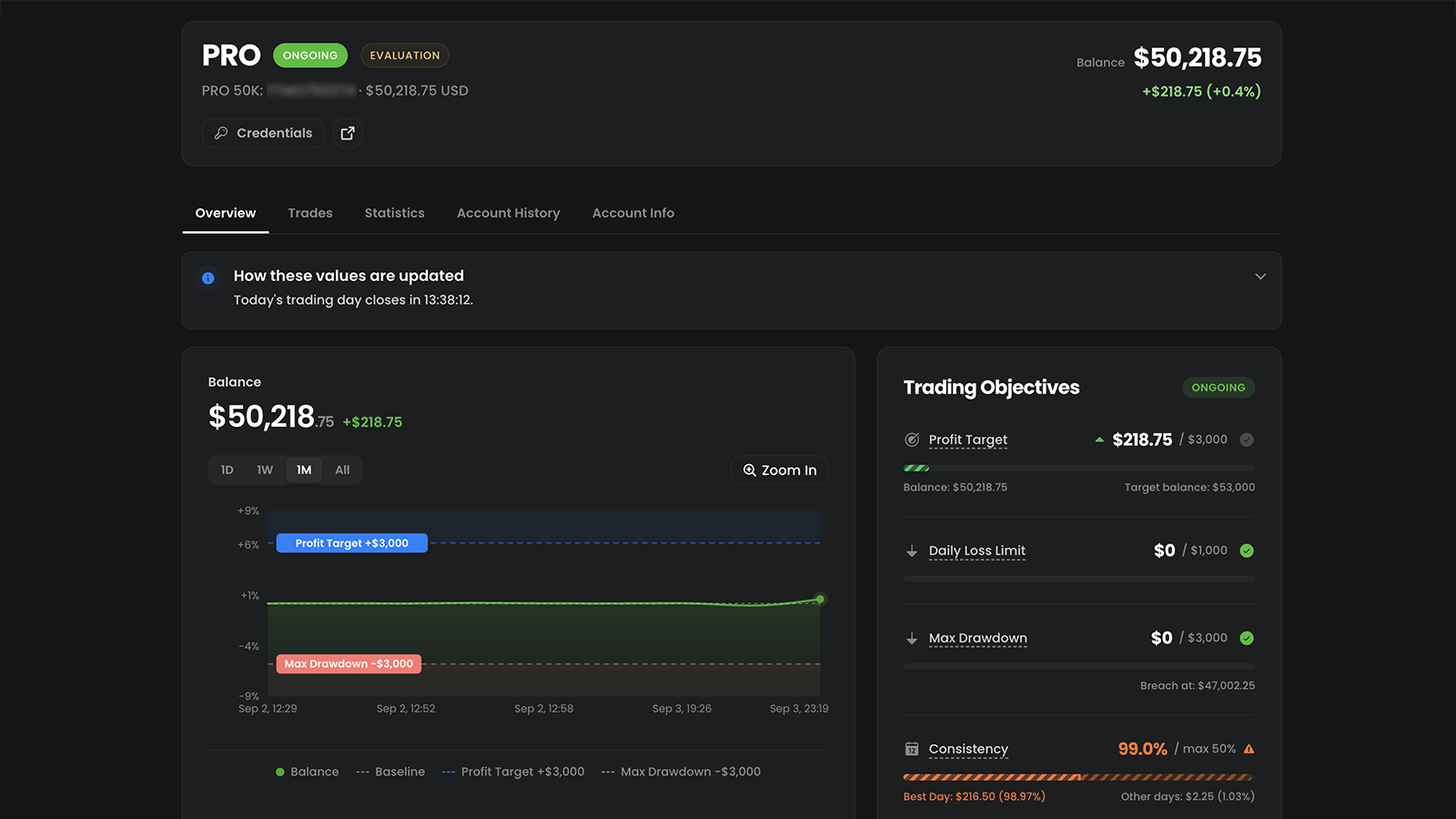
The account activated after checkout and exposed the selected program rules in the dashboard. The objectives surface made profit-target progress, daily-loss state, maximum-loss floor, and consistency visible together. That is useful because a green balance can still be ineligible to pass when one day contributes too much of the accumulated profit.
All six Evaluation plans in one view
FTMO Futures is a six-SKU decision, not a two-card decision. Hold the plan and account size together: every step up changes price, reset cost, profit target, daily boundary, EOD drawdown room, and the amount of profit concentration allowed during Evaluation.
GROWTH
50K$119 / mo
- Reset
- $109
- Target
- $3,000
- Daily loss
- None
- EOD drawdown
- $2,000 · EOD trailing
- Consistency
- 40% best-day limit
100K$169 / mo
- Reset
- $159
- Target
- $6,000
- Daily loss
- None
- EOD drawdown
- $3,500 · EOD trailing
- Consistency
- 40% best-day limit
150K$229 / mo
- Reset
- $219
- Target
- $9,000
- Daily loss
- None
- EOD drawdown
- $5,000 · EOD trailing
- Consistency
- 40% best-day limit
PRO
50K$139 / mo
- Reset
- $129
- Target
- $3,000
- Daily loss
- $1,000 · breach
- EOD drawdown
- $3,000 · EOD trailing
- Consistency
- 50% best-day limit
100K$199 / mo
- Reset
- $189
- Target
- $6,000
- Daily loss
- $1,500 · breach
- EOD drawdown
- $4,500 · EOD trailing
- Consistency
- 50% best-day limit
150K$269 / mo
- Reset
- $259
- Target
- $9,000
- Daily loss
- $2,000 · breach
- EOD drawdown
- $6,000 · EOD trailing
- Consistency
- 50% best-day limit
Evaluation → Sim-Funded: what changes after the target
The upper card answers the 50K Evaluation question directly. The transition below prevents that answer from being mistaken for the whole product: GROWTH adds a soft daily stop after passing, PRO keeps a hard daily boundary, both retain EOD trailing drawdown, and contract capacity starts from a lower dynamic tier.
GROWTH
Evaluation
- Target
- $3,000
- Daily loss
- None
- EOD drawdown
- $2,000 · EOD trailing
- Consistency
- 40% best-day limit
- Contracts
- 5 mini / 50 micro
Sim-Funded
- Target
- No target
- Daily loss
- $1,000 · pause
- EOD drawdown
- $2,000 · EOD trailing
- Consistency
- None
- Contracts
- 2→5 mini / 20→50 micro by EOD profit
PRO
Evaluation
- Target
- $3,000
- Daily loss
- $1,000 · breach
- EOD drawdown
- $3,000 · EOD trailing
- Consistency
- 50% best-day limit
- Contracts
- 5 mini / 50 micro
Sim-Funded
- Target
- No target
- Daily loss
- $1,000 · breach
- EOD drawdown
- $3,000 · EOD trailing
- Consistency
- None
- Contracts
- 2→5 mini / 20→50 micro by EOD profit
Payout eligibility and request gates
GROWTH
- Qualifying days by size
- 50K: 4 × $150 · 100K: 4 × $250 · 150K: 4 × $300
- Per-request caps by size
- 50K: $2,500 · 100K: $3,000 · 150K: $4,000
- Eligible share
- 50%
- Payout split
- 90/10
- Minimum request
- $20
- New profit required
- 50% of request
PRO
- Qualifying days by size
- 50K: 5 × $200 · 100K: 5 × $300 · 150K: 5 × $500
- Per-request caps by size
- 50K: $5,000 · 100K: $6,000 · 150K: $8,000
- Eligible share
- 100%
- Payout split
- 90/10
- Minimum request
- $20
- New profit required
- 50% of request
50K is the phase anchor above; payout thresholds and caps remain size-specific. Neither Sim-Funded plan uses an Evaluation-style consistency rule.
PRO is the room plan, but the daily stop is final
PRO's strongest 50K feature is the relationship between its nominal profit target and its maximum-loss distance. The exact values render in the table above, but the decision consequence is stable: this program gives more total room than GROWTH at the same account label. That can matter to a strategy with shallow daily losses but a wider multi-session recovery profile.
The counterweight is the hard daily-loss rule. It is not merely a personal alert and it is not a pause that clears at the next session. A history that occasionally produces a large losing day may collide with PRO even when its total drawdown remains controlled. The relevant test is the worst rule-counted session after commissions and any other costs the program includes—not a rounded gross P&L exported from a chart.
PRO also allows a higher best-day concentration than GROWTH during evaluation. A very large winning day can still raise the total profit needed before the consistency condition is met. The full FTMO Futures rules explanation separates immediate breaches, session pauses, and conditions that only delay eligibility.
GROWTH forgives a bad evaluation day differently
GROWTH removes the separate daily-loss limit during evaluation. Its maximum-loss floor still applies, so “no daily limit” does not mean unbounded loss. It means the account is governed by the total EOD-trailing floor instead of two simultaneous loss constraints.
After evaluation, the daily control returns as a soft stop. The reviewed rule set treats that event as a session pause rather than an account-ending breach. For a trader whose history contains occasional lumpy sessions but does not consume much total drawdown, that can be a meaningful form of forgiveness.
The cost of that forgiveness is visible elsewhere: the 50K maximum-loss distance is smaller, the consistency ceiling is tighter, and the payout path allows a smaller share of eligible profit per request than PRO. This is why “GROWTH is more permissive” is too broad. The PRO versus GROWTH decision guide turns those differences into four trader-history profiles.
The platform experience is practical, not magical
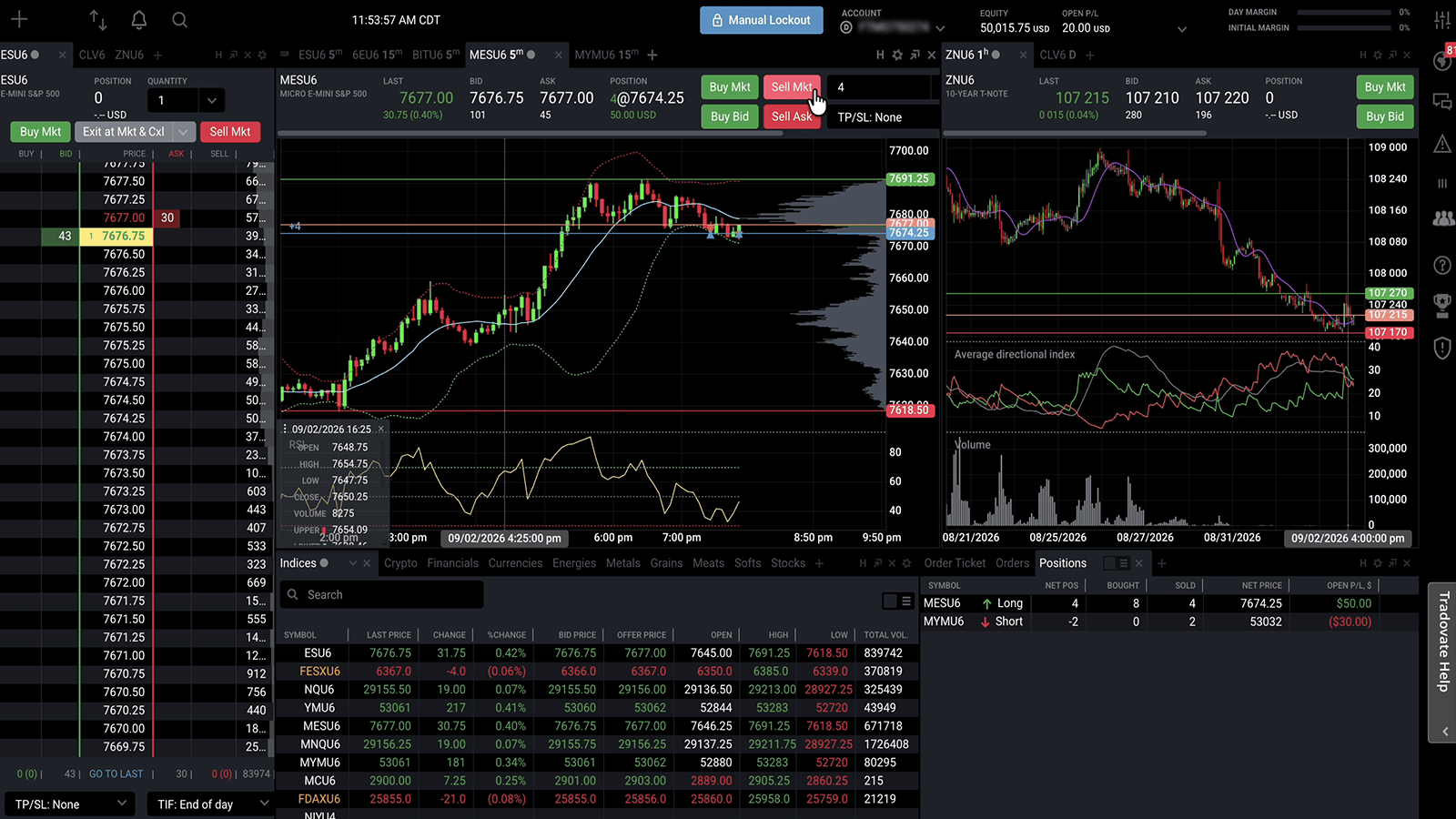
The tested account used Tradovate as the core environment, with TradingView and NinjaTrader listed as supported front ends. Tradovate delivered a usable order-entry and reporting workflow, but a trader coming from a different platform should validate symbol mapping, bracket behavior, session templates, commissions, and export fields before trading normal size.
The FTMO dashboard's statistics view covered useful single-account summaries such as performance by symbol and time. It did not replace the evidence layer needed to compare multiple accounts, preserve setup context, reconcile fee-separated exports, or replay another program's rule engine. An evaluation dashboard answers “where is this account now?” while a journal should answer “what produced the state, and does the same behavior survive another rule set?”
The export catch: gross results and costs can arrive separately
During the test, the practical export route ran through Tradovate reporting rather than one native FTMO Futures file. Position history carried the trade results, while cash history carried commissions and fees. Reading only the performance report would therefore overstate net results.
We reconciled the files before importing: stable account identity, source row identity, instrument, side, quantity, open and close timestamps, gross result, fee rows, and net result. The small test set balanced to the dashboard to the cent. That is a first-party workflow observation, not proof that every future export variant will map without review.
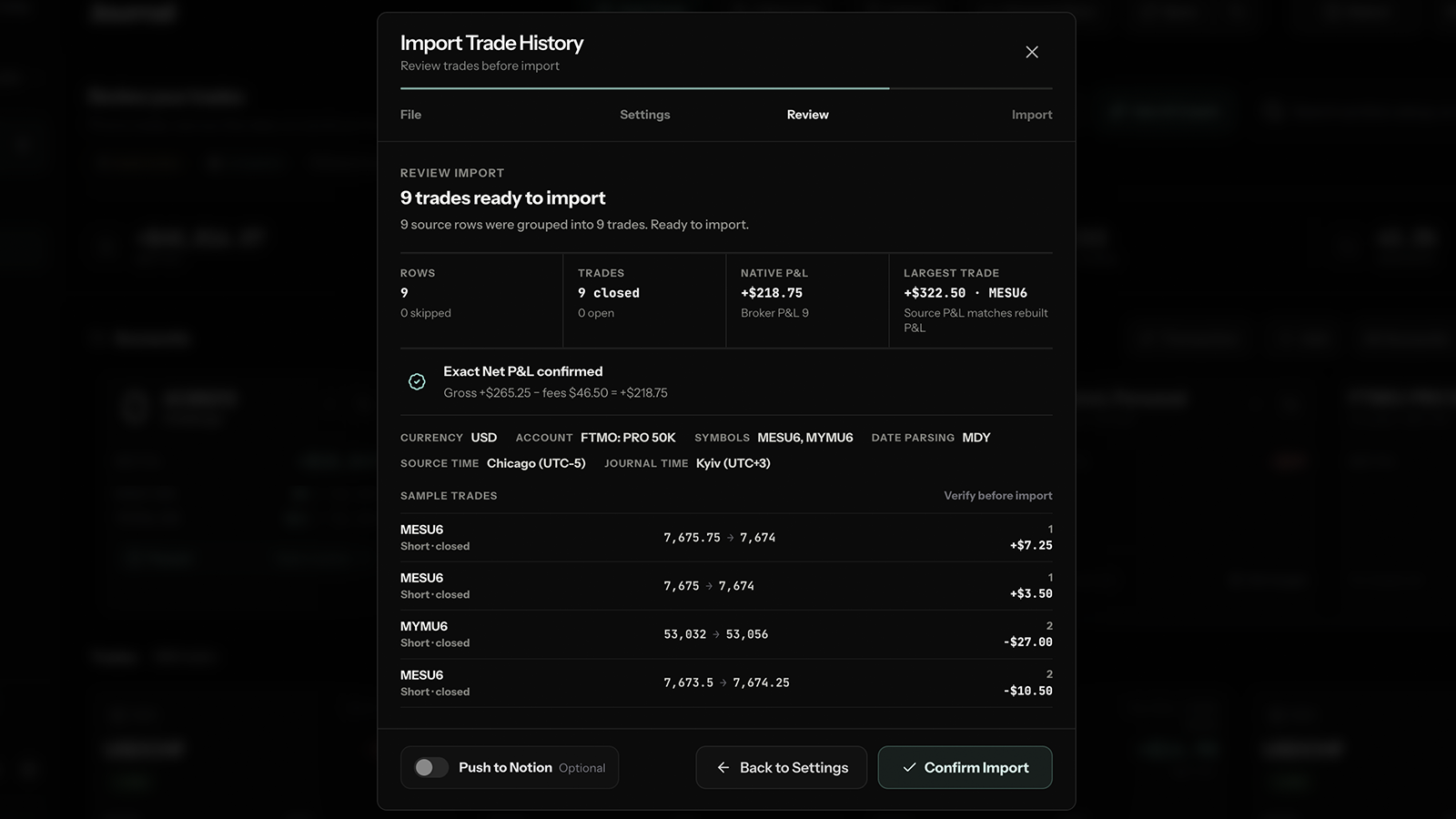
TSB's broader ingestion system has processed 600K+ cumulative imported trades and currently recognizes 330 source profiles. Those are product-scale counters, not the denominator of this private account test. The evidence here remains exactly the observed account and its eligible reconciled rows.
The most useful finding was not the P&L
When the short observed history was replayed, neither daily loss nor the maximum-loss floor was the binding issue. Profit distribution was. One winning day represented nearly all accumulated profit, so the account could be green while still requiring more distributed gains before it met the consistency objective.
That is a good example of what this product does well: the dashboard exposes the rule instead of letting the trader discover it after assuming the target alone decides the pass. It is also a limit on the conclusion. A resampled forecast from two days is not a durable pass-rate estimate, so this review does not publish one as a product promise.
Import a representative history and test the exact rule path in TSBThe subscription can cost more than the first screen suggests
A recurring price is not one fixed attempt cost. The relevant identity is subscription cycles plus resets plus tax and optional platform or data costs. Different numbers of subscription cycles can change the economic comparison even when two attempts begin on the same program.
Do not hide a no-payout path from the model. If a trader pays for several cycles and never reaches an eligible withdrawal, the full spend remains cost. If the trader resets, treat that as a new paid decision rather than erasing the failed attempt. The pricing and reset guide provides a scenario worksheet without freezing live amounts into prose.
Payout language needs five separate fields
A profit split is not the same as the share currently withdrawable. Frequency is not the same as processing time. A qualifying day is not any green day. A cap applies per request, and a new-profit condition can constrain the next cycle. The exact program and account size must stay visible beside every number.
PRO and GROWTH make different choices across those fields. PRO uses five qualifying days and permits more eligible profit to be requested within its cap. GROWTH uses four qualifying days, limits the eligible share and applies a lower cap. The FTMO Futures payout guide lays out the complete matrix and arithmetic order.
Who should shortlist each plan?
Shortlist PRO
Your history keeps daily losses controlled, benefits from more total drawdown room, and produces profits across enough sessions to meet consistency without changing the strategy.
Shortlist GROWTH
Your evaluation history is more vulnerable to a separate hard daily stop than to the tighter total floor, and you accept the different payout economics.
Shortlist neither yet
Your export cannot reconcile net results, your typical session approaches both loss floors, or the plan only works after changing size and behavior you have not validated.
If neither plan survives the representative-history test, broaden the shortlist through the existing futures prop-firm comparison. Do not force a launch product to fit merely because the operator is established.
Bottom line
FTMO Futures enters with a coherent dashboard, recognizable platform routes, explicit rule differences, and two plans that solve different problems. The product looked operational in our hands-on test. The honest remaining question is not legitimacy; it is whether the selected rule path and recurring-cost model fit your own net trading history.
PRO is the stronger shortlist candidate when room and eligible withdrawal access matter and hard daily control is already natural. GROWTH is the stronger candidate when an evaluation without a separate daily-loss breach matters more than maximum room. In both cases, verify the final released terms and replay a reconciled history before paying.