Calculate your risk-to-reward ratio before entering any trade. Know if the trade is worth taking.
The risk/reward ratio (R:R) compares how much you're risking on a trade versus how much you stand to gain. It's one of the most important metrics for evaluating trade quality before you enter.
Many traders obsess over win rate, but risk/reward is actually more important. With a 1:3 R:R ratio, you only need to win 25% of your trades to break even. This means you can be wrong 3 times out of 4 and still not lose money.
| R:R Ratio | Min Win Rate | Edge After Wins |
|---|---|---|
| 1:1 | 50% | Need high accuracy |
| 1:2 | 33% | Win 1 in 3 |
| 1:3 | 25% | Win 1 in 4 |
| 1:4 | 20% | Win 1 in 5 |
| 1:5 | 17% | Win 1 in 6 |
Your stop loss should be based on market structure — below support for longs, above resistance for shorts. Never adjust your stop to fit a desired R:R; that's backwards thinking.
Take profit levels should also be based on structure — previous highs/lows, supply/demand zones, or Fibonacci extensions. Don't set arbitrary targets just to get a good R:R.
If the calculation shows 1:1 or worse, consider skipping the trade unless you have a very high win rate strategy. Most professional traders won't take anything below 1:2.
You can take partial profits at 1:1 to lock in gains, then let the rest run for higher R:R. This balances security with profit potential.
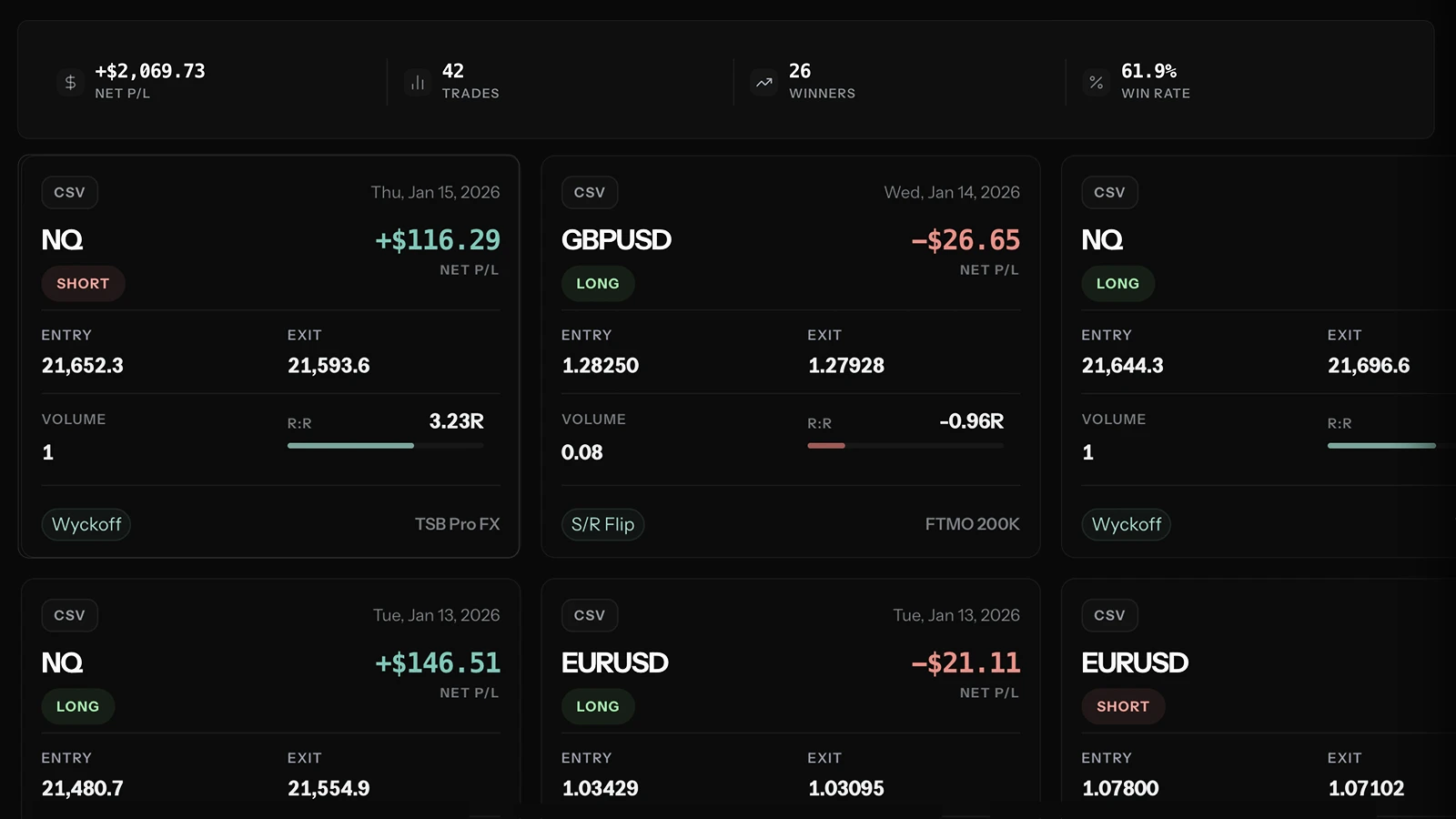
Trader's Second Brain tracks your planned vs actual R:R on every trade — so you can see if you're cutting winners short or letting losers run.
Trader's Second Brain auto-imports your trades from MT4, MT5, Binance & Bybit — then shows you which setups actually deliver the best risk/reward. One payment, no subscription.
Analyze your trades