Find what actually works
in your trading.
Use your own trade history to see which setups pay, which markets waste your time, which sessions hurt the account, and what rule should guide your next week.
Raw trades in.
Clear decisions out.
Add one batch of trades. TSB turns it into evidence: what works, what leaks, what deserves focus, and what rule to take into the next session.
Cut what leaks.
Every trade connects to setup, market, session, behavior, note, and screenshot, so the output is not another chart. It is what to trade more, stop touching, or test next.
Know what to trade more,
cut, and test next.
TSB connects journal context, AI review, backtests, playbook, prop tracking, and dashboards around the questions traders actually act on: what pays, what drains you, and what deserves more size or less attention.
Find the trades worth repeating.
Every trade keeps setup, session, screenshots, notes, tags, account, and review state next to the P/L, so you can tell whether a win was repeatable or just noise.
Test if the setup actually works.
Use AI questions to explain the decision, then test the setup against your own history before it earns a place in live trading.

Keep only setups with evidence.
The playbook separates core setups from ideas by sample size, expectancy, win rate, profit factor, drift, and execution quality.
Catch funded account risk early.
Prop Tracker keeps supported drawdown rules, targets, payout phase, rule checks, and account behavior visible before one bad session breaks the challenge.
See where your money really comes from.
Dashboard shows whether your best setups, markets, sessions, and discipline actually appear in equity, consistency, account stats, and calendar results.
Find the patterns
costing you money.
Behind the simple table, TSB compares your trades by setup, session, market, mistake, and P/L impact, then turns the deeper analysis into clear rules you can act on.
Your leaks and winners, ranked by impact.
See what is losing money, what is working, and the next rule to trade.
London is up +$2,410. Untagged Asia trades are down -$620.
Tag the setup before changing size or promoting the trade.
-$620Recent trades now average -$83 after previously averaging +$156.
Pause this setup until execution notes explain the drop.
-$664BOS wins 71.4% with PF 7.49. New York adds +$3,480.
Give BOS more focus in New York while keeping the daily risk cap.
+$3,480Stop after 2 losses, skip Friday PM, and review London BOS+FVG before adding size.
The parts around review
that make it usable.
Logging, cleanup, screenshots, notes, exports, reports, Notion, and rule carry are not the headline, but they decide whether review actually happens every week.
Spend less time preparing the review.
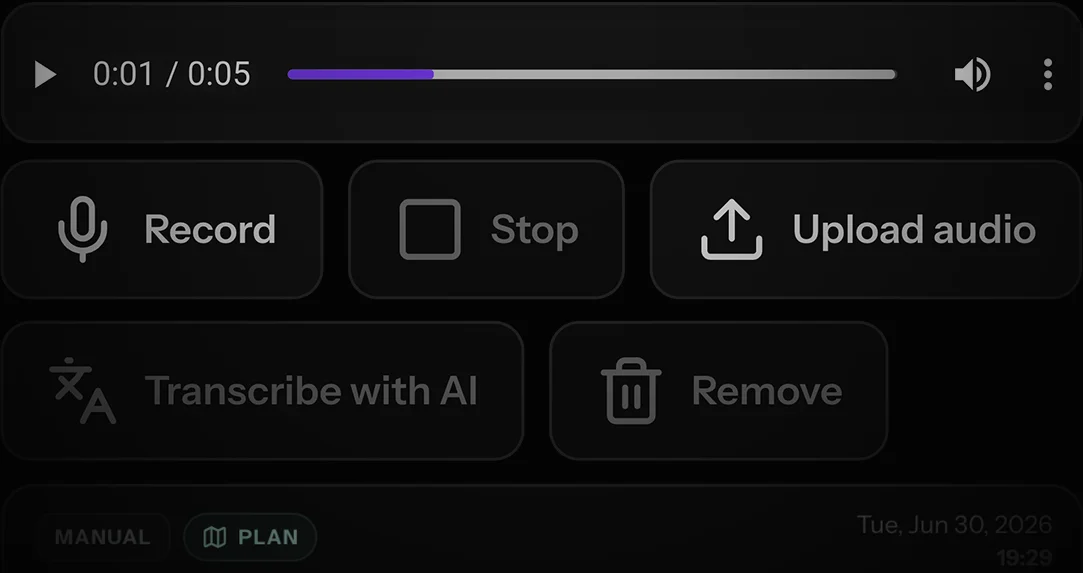
Manual logs, CSV, selected sync, broker exports, voice notes, screenshots, and optional Notion context all exist to get evidence into the same place faster.
Catch bad inputs before they pollute the review.
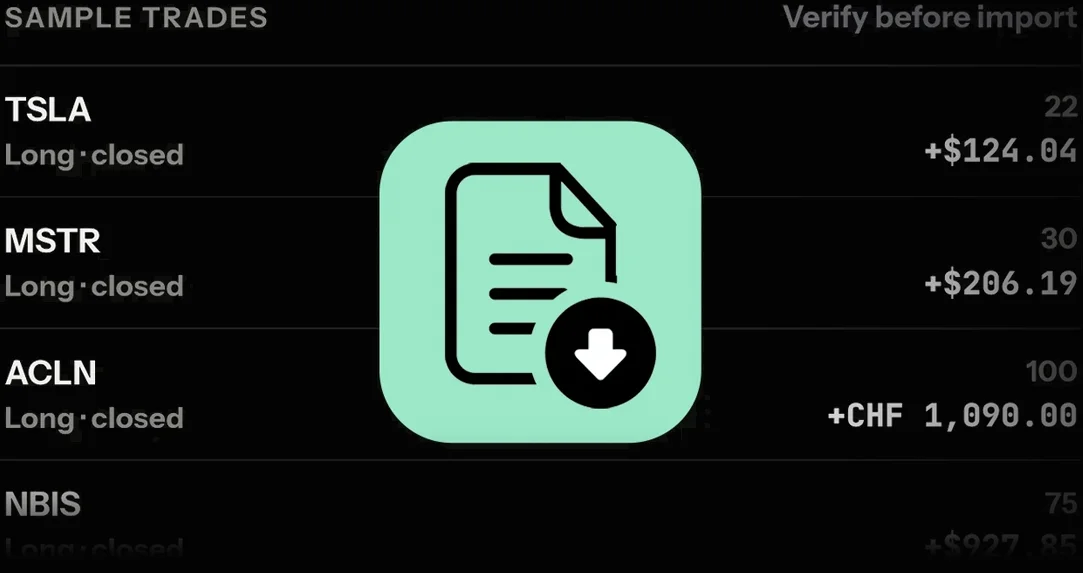
Import preview, currency checks, skipped-row warnings, duplicate handling, review status, and trade context help you trust the patterns you are seeing.
Leave with decisions, not just dashboards.
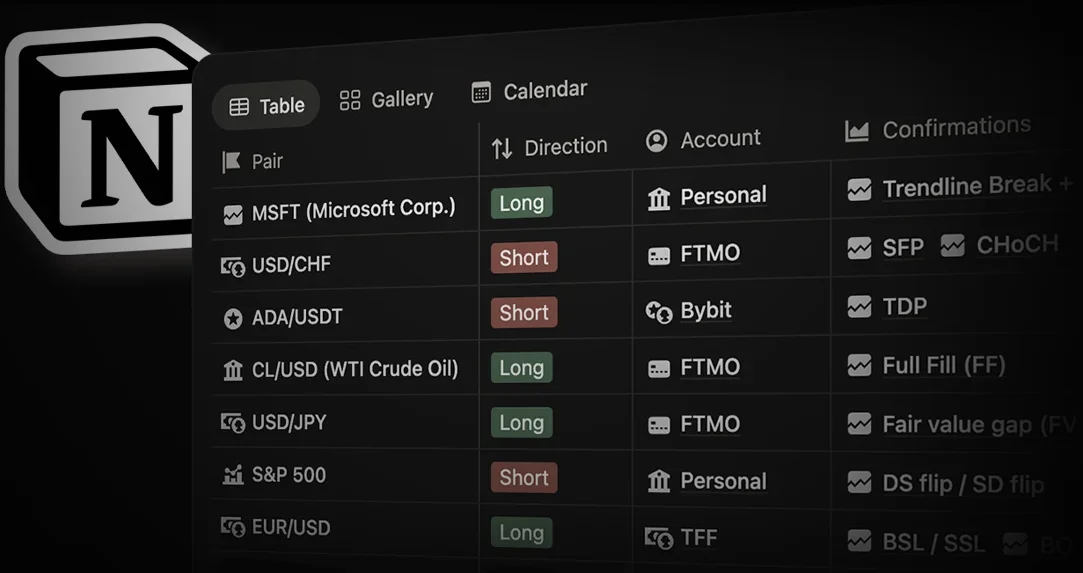
Send trades to Notion, export data, create reports, track supported prop rules, save playbook decisions, and carry one clear rule into the next session.
One bad pattern can erase your edge.
Use a simple model to see why small mistakes become expensive when they repeat. Inside TSB, the estimate is replaced by your real trade history.
A small leak becomes a line item when it repeats.
Adjust trades, repeat rate, average loss, and review window. The point is not prediction; it is deciding which behavior deserves review first.
Own the review system.
Not another subscription.
Pay once for the review workflow: AI, backtests, dashboards, playbook, and exportable data. Use your broker statement for accounting.
| Review Fit | TSB Best fit | TradeZella | TraderSync | Edgewonk | Excel |
|---|---|---|---|---|---|
| 3-Year Cost | $299 onceLifetime access | $1,188 | $1,080 | $591 | Free |
| Data Access | OwnedExport anytime | Subscription | Subscription | Local | Manual |
| AI Trade Review | IncludedBehavioral AI | No behavioral AI | No behavioral AI | No behavioral AI | No behavioral AI |
| Account-Level Review | UnlimitedAcross accounts | Paid tiers | Paid tiers | Not supported | DIY only |
| Notion Workflow | IncludedOptional workspace | No | No | No | DIY |
| Feature snapshot | |||||
| Price | $299 once | $396/yr | $360/yr | $197/yr | Free |
| Strategy Backtester | ✓ | ✓ | ✗ | ✓ | ✗ |
| Analytics Views | ✓ | ✓ | ✓ | ✓ | ✗ |
| Lifetime Access | ✓ | ✗ | ✗ | ✗ | ✓ |
| Time To Start | <60 sec | 5-10 min | 5-10 min | 10-15 min | Hours |
Comparison based on publicly available data as of March 2026. Features and pricing may change.
What traders find
after the review
Patterns, leaks, and rules that were hard to see while trades lived in scattered notes, broker exports, or memory.
Imported 312 MT5 trades. The leak was obvious: XAU/USD after two red trades was down $1,840.
On a $100k FTMO challenge, TSB showed the daily drawdown risk was re-entry, not position size.
Bybit import grouped 68 BTC and ETH trades. My 58% win rate looked fine until Asia session showed the drag.
MT5 sync pulled EUR/USD and NAS100 into the journal. Friday PM had 12 trades, 9 red. That became rule one.
Finally one place connecting win rate, setup, and notes. My 62% London BOS was hidden under flat P/L.
My TopStep combine kept slipping after trade four. TSB made the rule simple: max 3 trades after NY open.
I was paying monthly just to store trades. Here the CSV, screenshots, and rules live together, and I can export them.
XAU/USD Friday PM was -$620 across 14 trades. I knew it felt bad; TSB made it measurable.
The next-session rule is what made it stick. After two red trades, review comes before any re-entry.
Imported 312 MT5 trades. The leak was obvious: XAU/USD after two red trades was down $1,840.
On a $100k FTMO challenge, TSB showed the daily drawdown risk was re-entry, not position size.
Bybit import grouped 68 BTC and ETH trades. My 58% win rate looked fine until Asia session showed the drag.
MT5 sync pulled EUR/USD and NAS100 into the journal. Friday PM had 12 trades, 9 red. That became rule one.
Finally one place connecting win rate, setup, and notes. My 62% London BOS was hidden under flat P/L.
My TopStep combine kept slipping after trade four. TSB made the rule simple: max 3 trades after NY open.
I was paying monthly just to store trades. Here the CSV, screenshots, and rules live together, and I can export them.
XAU/USD Friday PM was -$620 across 14 trades. I knew it felt bad; TSB made it measurable.
The next-session rule is what made it stick. After two red trades, review comes before any re-entry.
For my FundedNext account, the issue was not the profit target. It was one rule break near max daily loss.
New York 9:30-11:00 was 71% WR. After lunch was negative. I stopped mixing those sessions together.
The AI asked why I entered my third GBP/JPY trade. I had no answer, and the tag history proved it.
My weekly review showed 43 trades, but only 11 were playbook setups. That changed what I tracked next week.
The what-if view put a number on overtrading: about $540 of avoidable drag in one month of small trades.
Equity by setup separated FVG from everything else. One setup had PF 2.4; the rest was just noise.
I connected Oanda, then realized my “good” EUR/USD idea was only working in London, not New York.
IBKR import removed the excuse. 126 equity trades were already there, so the Sunday review actually happened.
After trade four, my quality dropped from A/B to C setups. Seeing that row made the limit easy to accept.
For my FundedNext account, the issue was not the profit target. It was one rule break near max daily loss.
New York 9:30-11:00 was 71% WR. After lunch was negative. I stopped mixing those sessions together.
The AI asked why I entered my third GBP/JPY trade. I had no answer, and the tag history proved it.
My weekly review showed 43 trades, but only 11 were playbook setups. That changed what I tracked next week.
The what-if view put a number on overtrading: about $540 of avoidable drag in one month of small trades.
Equity by setup separated FVG from everything else. One setup had PF 2.4; the rest was just noise.
I connected Oanda, then realized my “good” EUR/USD idea was only working in London, not New York.
IBKR import removed the excuse. 126 equity trades were already there, so the Sunday review actually happened.
After trade four, my quality dropped from A/B to C setups. Seeing that row made the limit easy to accept.
Full access. Paid once.
Start free on your own data. Upgrade once for Leak Map, AI Coach, Backtester, Playbook, reports, and unlimited account history.
Complete review system.
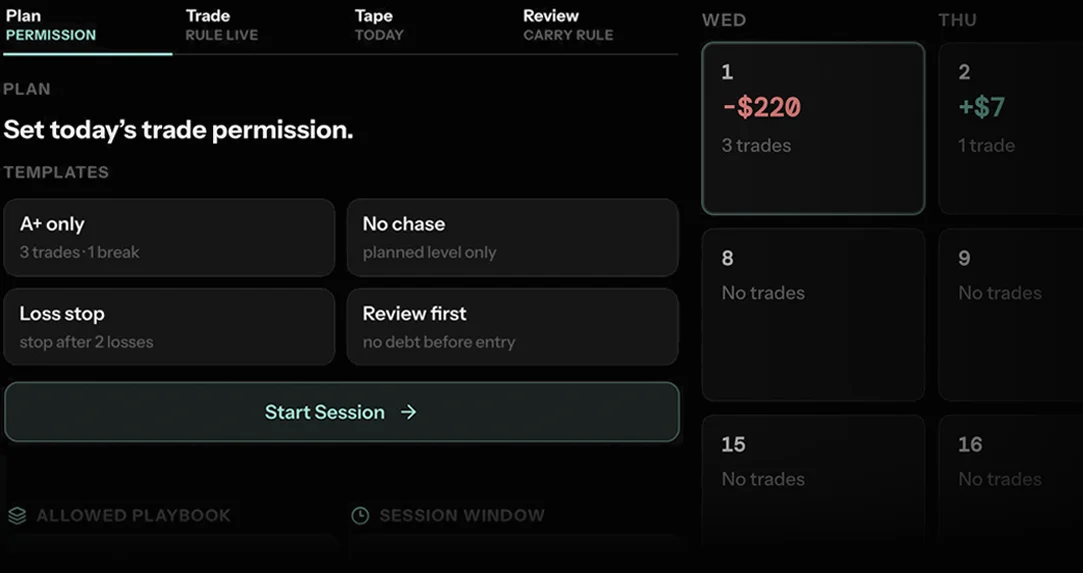
Import trades. Find leaks. Trade the next session with one clear rule.
- Trade intakeManual log, CSV, selected sync, broker exports
- Journal contextTable, grid, calendar, tags, screenshots, review state
- Leak MapRepeated behavior, evidence, impact, next rule
- AI CoachExplanations and voice debrief on your trade history
- BacktesterTest setups against real trade behavior
- PlaybookSeparate proven setups from ideas
- ReportsWeekly, monthly, yearly review summaries
- Capital checksAccount cards, cash flow, partial exits, discipline proof
Built from execution mistakes. Not theory.
I didn’t need more charts. I needed a feedback loop that showed me what was breaking down and what to fix next.
TSB started from a simple problem: trades were logged, but the repeating mistakes behind them were still hard to see. The product became a daily review system for finding what is leaking, what is working, and what deserves the next rule.
Built for traders who want evidence, ownership, and a workflow they can keep.
Last questions before you start?
Short answers before you test the workflow on your own trades.