Know exactly how much to trade before you enter. Calculate your lot size, dollar risk, and risk-per-pip for forex, crypto, and futures trades.
Wider stops need smaller size to keep the same account risk.
Enter account balance, risk percentage, stop-loss distance, and pip value. The calculator returns the lot size, units, maximum dollar risk, and risk per pip before the trade is placed.
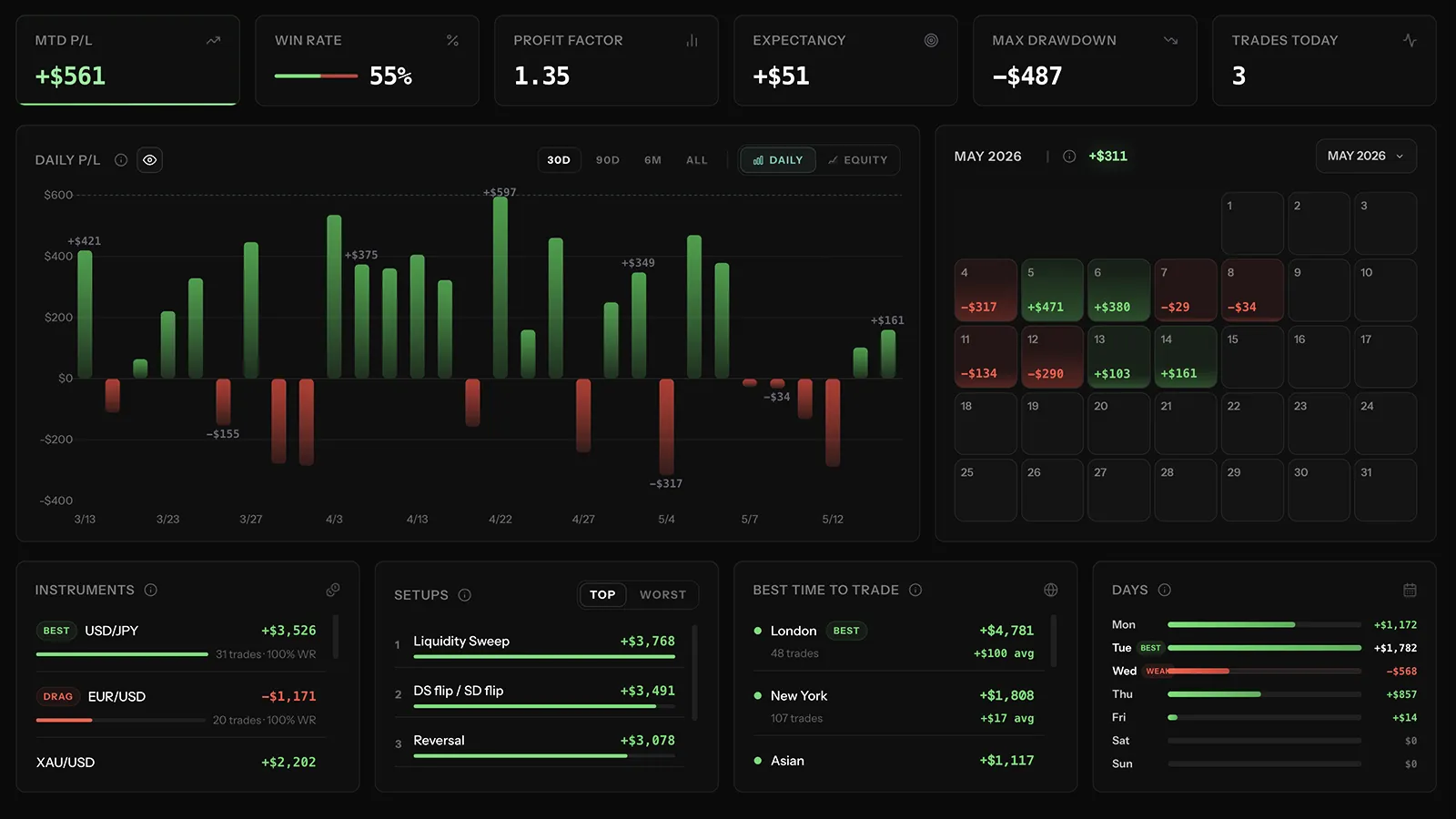
Import your trade history and see whether your risk actually stays consistent across setups, sessions, and markets. TSB shows the trades that respect your plan and the ones that quietly break it.
Position sizing is one of the most critical aspects of risk management in trading. It determines how many lots, units, or contracts you should trade based on your account size and how much you're willing to risk.
Many traders focus on entry and exit signals while ignoring position sizing — this is a critical mistake. Here's why proper position sizing is essential:
Even the best trading strategies have losing streaks. With proper position sizing, a streak of 10 losses at 1% risk only reduces your account by about 10%. Without it, the same streak could wipe out your entire account.
Different stop-loss distances shouldn't mean different dollar risks. A 20-pip stop and a 100-pip stop should both risk the same percentage of your account — position sizing makes this possible.
When you know your maximum loss before entering a trade, you can trade without fear. This leads to better decision-making and fewer emotional mistakes.
The core formula stays the same across markets, but pip values, contract sizes, and tick increments differ. Here's how position sizing works for the four most popular asset classes.
| Asset Class | Unit | Typical Pip/Tick Value | Position Size Formula Adjustment |
|---|---|---|---|
| Forex | Lots (100K units) | $10 per pip (standard lot) | Risk$ ÷ (SL pips × $10) |
| Crypto | Coins / contracts | Varies by coin price | Risk$ ÷ (SL in $ per coin) |
| Stocks / ETFs | Shares | $1 per share per $1 move | Risk$ ÷ (SL in $ per share) |
| Futures (ES, NQ) | Contracts | ES: $12.50/tick, NQ: $5/tick | Risk$ ÷ (SL ticks × tick value) |
Key takeaway: always convert your stop-loss to dollars-at-risk first, then divide by your risk budget. The calculator above handles this automatically for forex — for other asset classes, use the dollar-based formula.
Don't want to calculate every time? Use this table for standard forex pairs ($10/pip). Find your account size, risk level, and stop-loss distance to get your lot size instantly.
| Account | Risk % | Risk $ | SL 20 pips | SL 50 pips | SL 100 pips |
|---|---|---|---|---|---|
| $5,000 | 1% | $50 | 0.25 lots | 0.10 lots | 0.05 lots |
| 2% | $100 | 0.50 lots | 0.20 lots | 0.10 lots | |
| 3% | $150 | 0.75 lots | 0.30 lots | 0.15 lots | |
| $10,000 | 1% | $100 | 0.50 lots | 0.20 lots | 0.10 lots |
| 2% | $200 | 1.00 lots | 0.40 lots | 0.20 lots | |
| 3% | $300 | 1.50 lots | 0.60 lots | 0.30 lots | |
| $25,000 | 1% | $250 | 1.25 lots | 0.50 lots | 0.25 lots |
| 2% | $500 | 2.50 lots | 1.00 lots | 0.50 lots | |
| 3% | $750 | 3.75 lots | 1.50 lots | 0.75 lots | |
| $50,000 | 1% | $500 | 2.50 lots | 1.00 lots | 0.50 lots |
| 2% | $1,000 | 5.00 lots | 2.00 lots | 1.00 lots | |
| 3% | $1,500 | 7.50 lots | 3.00 lots | 1.50 lots | |
| $100,000 | 1% | $1,000 | 5.00 lots | 2.00 lots | 1.00 lots |
| 2% | $2,000 | 10.00 lots | 4.00 lots | 2.00 lots | |
| 3% | $3,000 | 15.00 lots | 6.00 lots | 3.00 lots |
Prop firm traders: most challenges use $100K or $200K accounts with strict 5% daily loss limits. At 1% risk per trade with a 50-pip stop, you'd trade 2.00 lots on a $100K account — leaving room for 5 open trades before hitting the daily limit.
