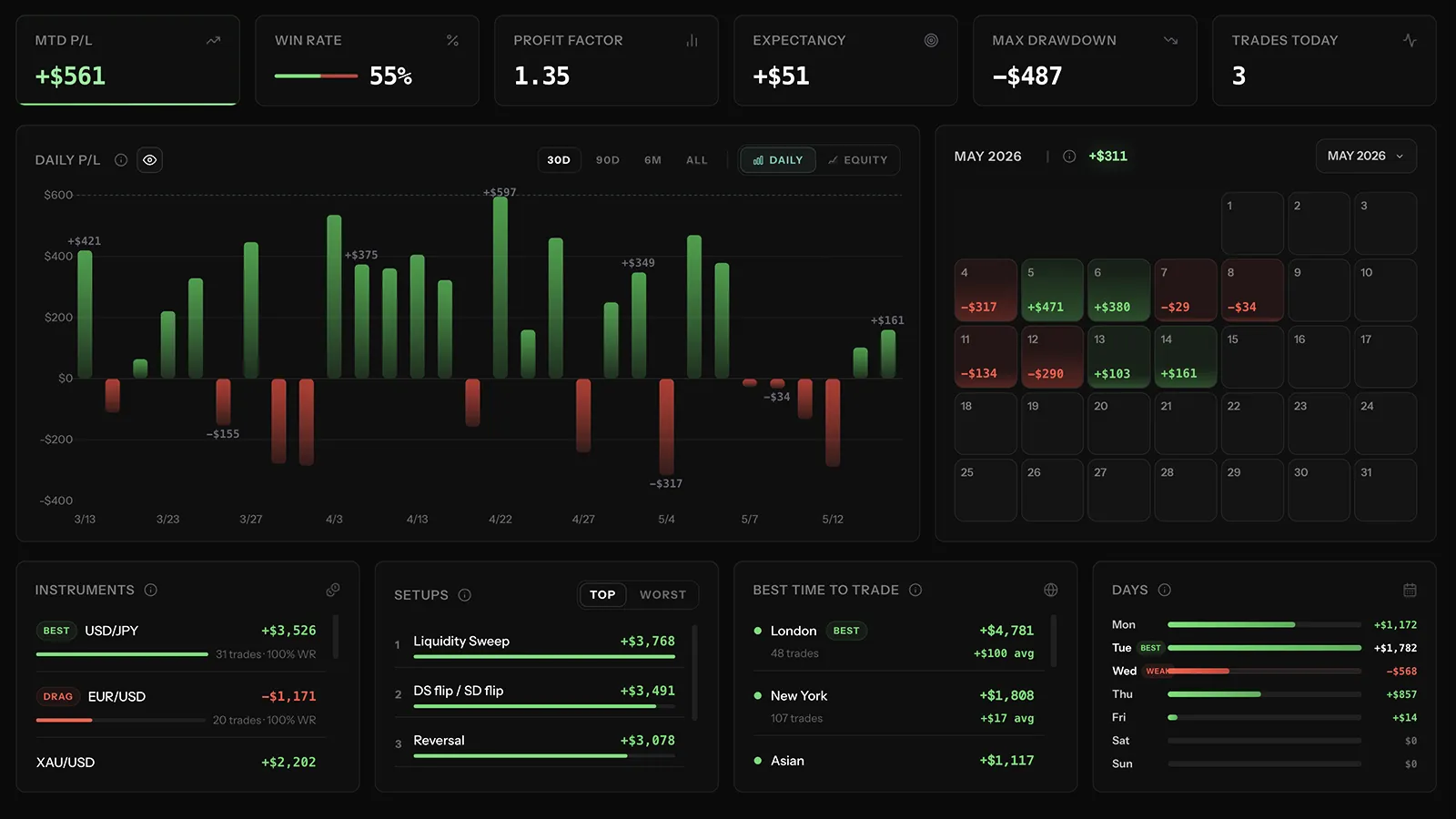
The Asymmetry of Drawdowns
One of the most important concepts in trading is that losses and gains are not symmetric. A 50% loss does not require a 50% gain to recover — it requires 100%.
Drawdown Recovery Table
| Loss |
Gain to Recover |
Difficulty |
| -10% |
+11.1% |
Easy |
| -20% |
+25% |
Manageable |
| -30% |
+42.9% |
Challenging |
| -40% |
+66.7% |
Difficult |
| -50% |
+100% |
Very Hard |
| -75% |
+300% |
Nearly Impossible |
| -90% |
+900% |
Account Blown |
Why This Matters
- Prevention > Recovery — It's easier to avoid a 20% loss than to recover from it
- Risk management is everything — Small losses (1-2%) are easily recovered
- Compounding works both ways — Losses compound against you
- Psychological impact — Large drawdowns destroy confidence and lead to revenge trading
Frequently Asked Questions
What is drawdown in trading?
Drawdown is the peak-to-trough decline in your trading account. If your account goes from $10,000 to $8,000, that's a 20% drawdown. It measures the largest loss from a peak before a new peak is reached.
How much gain to recover from a 50% loss?
A 50% loss requires a 100% gain to recover. If you lose half ($10,000 → $5,000), you need to double your money to get back to $10,000. This asymmetry is why risk management is crucial.
What is a good maximum drawdown?
Most professional traders aim for maximum drawdown under 20%. Prop firms typically allow 5-10% daily and 10-12% overall. Anything above 30% becomes very difficult to recover from psychologically and mathematically.
How do you calculate drawdown?
Drawdown % = (Peak Value - Trough Value) / Peak Value × 100. If your account peaked at $12,000 then dropped to $9,000, drawdown = ($12,000 - $9,000) / $12,000 × 100 = 25%.
Why is drawdown important in trading?
Drawdown shows your worst-case scenario and tests your risk management. Large drawdowns are hard to recover from (50% loss needs 100% gain), damage confidence, and can lead to revenge trading. Keeping drawdowns small is key to longevity.